The conversation around AI Literacy vs AI Training is becoming increasingly important for CHROs, L&D leaders, and business heads in mid- sized companies.
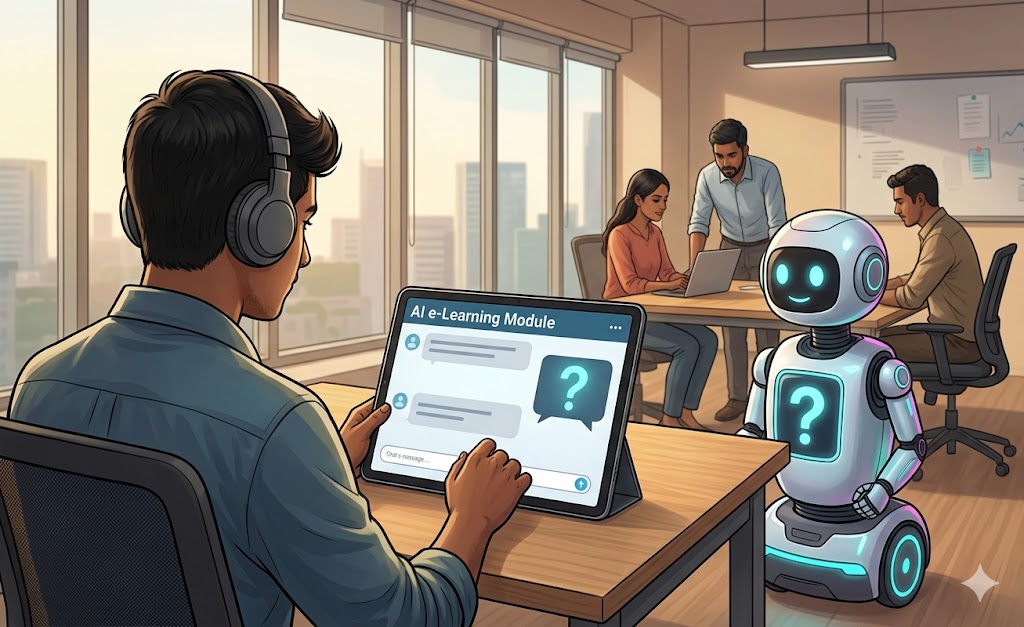
Many organizations are investing in AI tools before preparing employees to use them responsibly, productively, and strategically through structured e-learning. Employees are already experimenting with ChatGPT, Copilot, Gemini, and other AI platforms across departments. But using AI tools does not automatically make a workforce AI ready.
That is the gap many companies are now discovering.
An employee may know how to generate a presentation with AI, but may not understand the risks of uploading confidential data into public platforms. A manager may use AI to draft client communication, but may not know how to verify AI generated outputs before sending them externally.
This is why companies need to clearly understand the difference between AI literacy and AI training through scalable AI e-learning modules which can be used to train employees on responsible and safe use of AI within the company guiderails.
These are not interchangeable concepts. They solve different business problems and together they form the foundation of successful AI adoption strategy.
Why AI Literacy vs AI Training Matters for Companies
Many mid-sized companies are currently approaching AI adoption backwards.
They begin with AI tool demonstrations and productivity workshops before building foundational understanding on AI e-learning for employees. The result is usually inconsistent adoption, employee confusion, misuse risks, and low long term impact.
AI learning for corporate employees needs structure.
Organizations first need employees who understand:
- What AI can and cannot do
- Where AI generated outputs can go wrong
- How to use AI responsibly at work
- Why data privacy matters
- When human judgment is still essential
Only after that foundation is built through AI literacy e-learning, should organizations move toward role based AI training.
This sequence matters more than most companies realize.
What is AI Literacy in the Workplace?
AI literacy is the foundational awareness employees need before actively integrating AI into daily work.
It focuses on understanding, judgment, and responsible usage rather than technical expertise.
An AI literate employee understands:
- The strengths and limitations of AI
- How hallucinations and inaccuracies happen
- Why AI outputs require verification
- The importance of data protection
- Ethical concerns around AI usage
- How AI impacts workplace productivity and decision making
AI literacy e-learning helps employees think critically while using AI.
For example, an HR professional using AI for policy drafting should know:
- Why sensitive employee data should not be pasted into public AI tools
- Why AI generated policies still require human review
- How AI generated recommendations may unintentionally introduce bias
Similarly, a sales professional using AI for proposal writing should understand:
- Why AI generated claims on sales statistics must be verified
- How poor prompts create weak outputs
- Why personalization still matters in client communication
AI literacy creates responsible AI behavior across the workforce.
What is AI Training for Corporate Employees?
AI training focuses on practical execution and productivity improvement.
It teaches employees how to use AI tools effectively within their specific roles and workflows through structured e-learning modules.
This may include:
- Prompt writing techniques
- AI assisted reporting
- AI for content creation
- AI powered research workflows
- AI assisted customer support
- AI for HR operations
- AI productivity automation
Unlike AI literacy, AI training is highly task oriented.
For example:
- Training recruiters to use AI for resume screening
- Teaching managers how to generate meeting summaries
- Helping sales teams create faster proposals
- Enabling marketing teams to improve campaign workflows using AI
AI e-learning modules improve operational efficiency.
But without AI literacy, employees may use these tools incorrectly, carelessly, or without understanding organizational risks.
The Biggest AI Adoption Mistake Mid-Sized Companies Are Making
Many companies are moving directly into AI tool training without building workforce readiness first through AI e-learning.
This is already creating practical problems across industries.
A finance employee uploads confidential data into an AI platform without understanding privacy implications.
A manager relies entirely on AI generated analysis before a client presentation.
An employee copies AI generated content without verifying factual accuracy.
A marketing team unknowingly publishes AI generated content with compliance or copyright concerns.
These are not technology failures.
They are workforce preparedness failures.
This is why AI literacy e-learning is becoming essential before advanced AI deployment across organizations.
AI Literacy vs AI Training: A Practical Framework
The simplest way to understand AI Literacy vs AI Training is this:
| AI Literacy | AI Training |
|---|---|
| Builds awareness | Builds execution capability |
| Focuses on understanding | Focuses on workflows |
| Covers judgment and risks | Covers productivity and usage |
| Applies organization wide | Applies role wise |
| Encourages responsible usage | Encourages efficient usage |
| Creates readiness | Creates capability |
The strongest AI e-learning strategies combine both.
AI literacy creates the foundation. AI training builds the application layer.
Organizations that skip the first step often struggle with inconsistent adoption and avoidable risk exposure.
Why Mid-Sized Companies Need Structured AI E-Learning for Employees
Large enterprises often have dedicated AI governance teams, cybersecurity functions, and digital transformation budgets.
Mid-sized companies usually operate with leaner structures and faster decision cycles.
That creates both risk and opportunity.
Employees in mid-sized companies often adopt AI independently before formal policies or learning frameworks are introduced. At the same time, these organizations can move faster than large enterprises once the workforce is aligned through AI e-learning.
Companies that invest early in AI learning for corporate employees often see:
- Faster AI adoption
- Better productivity outcomes
- More confident managers
- Higher employee engagement
- Better collaboration across teams
- Lower misuse risks
The key is scalable and structured AI e-learning.
Why AI E-Learning is Becoming Critical for Workforce Readiness
AI capabilities are evolving continuously. A one time workshop or webinar is no longer enough.
Organizations now need continuous AI e-learning programs that employees can access practically and consistently.
This is where AI e-learning is becoming highly valuable for mid- sized companies.
Companies increasingly need:
- Scalable AI e-learning programs
- Role based learning paths
- SCORM compatible AI learning modules
- Employee login based access
- Trackable learning completion
- Practical business focused use cases
- Continuous workforce upskilling
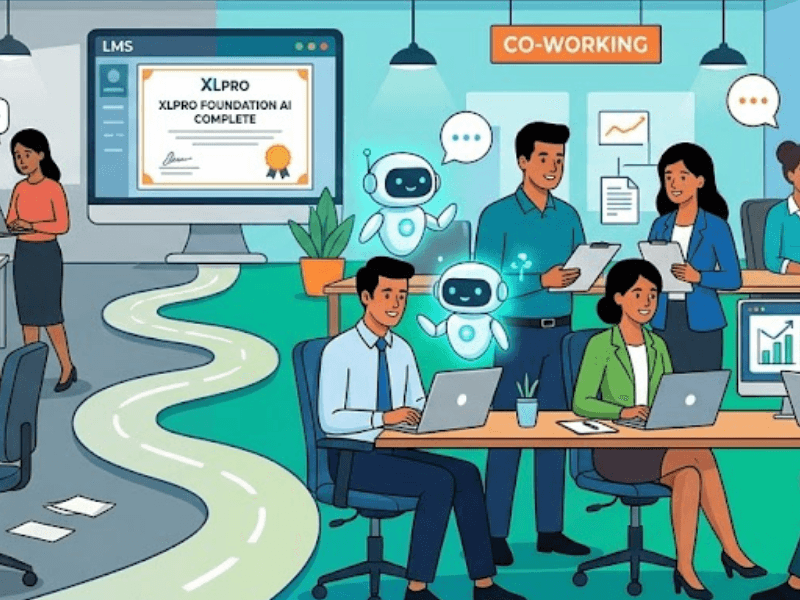
XLPro E-Learning can help organizations build AI readiness through structured AI e-learning modules designed specifically for corporate employees. With SCORM based deployment, practical workplace scenarios, and scalable employee learning access, organizations can train distributed teams consistently while supporting long term AI adoption strategy.
This becomes especially important for CHROs and L&D leaders trying to balance productivity, governance, and workforce readiness together.
What CHROs and L&D Leaders Should Do Next
The conversation should no longer be whether employees will use AI.
They already are.
The real question is whether organizations are preparing employees to use AI effectively and responsibly through structured AI e-learning.
A practical approach looks like this:
Step 1: Build AI Literacy Across the Workforce
Create foundational awareness through AI literacy e-learning before introducing advanced tools.
Step 2: Introduce Role Based AI Training
Use AI training e-learning programs to train departments differently based on business use cases.
Step 3: Define AI Usage Guidelines
Employees need clarity around acceptable AI usage and risk boundaries.
Step 4: Measure Productivity Outcomes
Track whether AI e-learning improves speed, quality, and decision making.
Step 5: Keep AI Learning Continuous
AI e-learning cannot remain a one time initiative.
Conclusion
AI adoption is accelerating faster than workforce preparedness in many organizations. That gap creates both opportunity and risk for mid-sized companies.
Organizations that focus only on AI tools may generate short term excitement but long term inconsistency. Companies that first build AI literacy through e-learning and then introduce AI training create a stronger foundation for sustainable AI adoption.
For CHROs, L&D leaders, and business heads, this is no longer just a technology discussion. It is a workforce readiness discussion.
Because the companies that succeed with AI will not simply be the ones with access to AI tools.
They will be the ones whose employees actually know how to use them well through practical AI e-learning.