You think your team is using AI. Have you actually checked?
Buying the tool feels like the decision. The announcement, the rollout email, the IT setup, it all feels like action. And once that’s done, most companies assume the rest will follow.
It doesn’t.
88% of companies globally have deployed AI in at least one function (Source: McKinsey State of AI 2025). Only 35% have a mature, organisation-wide training programme (Source: Data Camp/Iternal AI Skills Gap 2026) . In India, 43% of the workforce uses AI at work but only 31% feel genuinely prepared to use it well (Source: Deloitte-Nasscom 2024). Which means in a company of 500 roughly 345 of them have not received any structured AI training and they are either figuring it out on their own or not touching it at all.
Deployed is not the same as adopted. And adopted is not the same as effective.
That gap between access and capability is where productivity goes to die.
The assumption that’s costing you
The assumption most founders, CEOs or CHROs make is that access equals adoption. We bought the tool, we announced it, we sent the login details. Job done.
But think about the last time your company introduced any new tool without training. A new CRM. A new project management system. What happened? Six people used it properly. The rest worked around it. And within three months everyone had quietly gone back to doing things their own way.
AI training for employees in India is the same story, just bigger and faster moving. Because unlike a CRM, the gap between someone who knows how to use AI and someone who doesn’t isn’t just a productivity gap. It compounds every single week.
Right now in your company there’s almost certainly someone who has genuinely figured out how to use AI and is saving two or three hours a week because of it. There’s also someone who tried it twice, got results that weren’t useful, and hasn’t touched it since. And there’s probably a larger group who opened it once out of curiosity and then closed it.
None of them were trained. All of them were given access. And you, unless you’ve specifically gone looking, have no idea which category most of your team falls into.
That’s not an AI problem. That’s a visibility problem that’s been sitting quietly in your organisation for the last year.
What’s actually happening on the ground
Here’s what unmanaged AI adoption looks like inside a mid-sized Indian company.
Your top performers, the ones who figure everything out early are already using AI well. They taught themselves, found what works, and quietly built it into how they work. They’re not telling anyone because it feels like a personal advantage.
Your middle group tried it a few times. Got some useful outputs, got some rubbish ones, never really understood why. They use it occasionally when they remember it exists. Mostly they don’t.
Your bottom group and in most companies this is larger than anyone wants to admit, haven’t really engaged with it at all. Not because they’re resistant. Because nobody showed them what to do with it and they weren’t confident enough to experiment on their own.
Three completely different realities. One company.
The gap between your best AI users and the rest is getting wider every month. The people who are good at it are getting better. The people who aren’t have stopped trying.
Why the usual fixes don’t close the gap
Most Indian companies respond to this problem in one of three ways. None of them work.
The first is encouragement. An email from HR, a message from the CEO, a town hall where someone demonstrates ChatGPT for ten minutes. This reaches the people who were already curious. Everyone else nods and goes back to their desk unchanged.
The second is access to online learning. A subscription to a platform, a curated list of AI courses, an internal resource page that three people have visited. Here’s the reality-82% of enterprise leaders say their organisation provides some form of AI training, yet 59% still report a significant AI skills gap (Source: Data Camp 2026) . The training exists. It’s just not working. And the reason, according to a 2026 Data Camp study, is that most of it is fragmented, optional, and completely disconnected from what employees actually do at their desks.
The third is a leadership workshop. Senior team spends a day understanding AI strategy and use cases. They come back energized. The 400 people who weren’t in the room are exactly where they were before.
None of these are bad decisions. They just don’t create consistency. They create pockets of knowledge in a company that already had pockets of knowledge. The gap of lack of structured AI training for employees stays exactly where it was.
What actually closes the gap
Proper AI training for employees means the same thing happening to every person. Not the same tool being available but the same experience, the same foundation, the same baseline.
That means one course. Mandatory. For everyone. Short enough that it actually gets done.
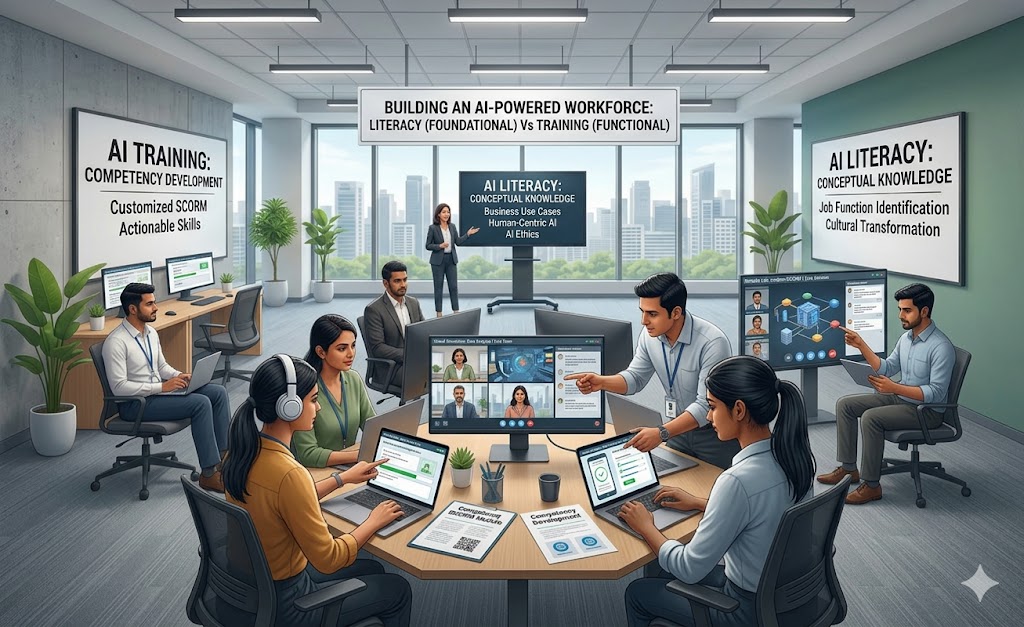
The companies closing this gap fastest aren’t running transformation programmes. They’re doing something much simpler. They’re picking a 30 minute AI training course, making it non-optional, and having every single employee complete it within 30 days. Finance, operations, sales, admin almost everyone. Same baseline. Same starting point.
After that, the people who want to go deeper can go deeper. But at least the foundation is the same.
Three things is all it takes to build a real baseline. Every employee should be able to write a prompt that gets a useful answer not just ask a vague question, but frame it with enough context that the output is actually usable. They should be able to evaluate what AI gives them and know when to trust it, when to check it, when to ignore it. And they should be able to apply it to at least one task they do every week.
Those three things, applied consistently across your whole company, change the picture completely. Research from BCG backs this up “Employees who receive at least five hours of structured AI training show significantly higher usage and confidence than those who self-teach. The training doesn’t have to be long. It has to be deliberate.”
The mid-sized company advantage nobody talks about
Here’s something the big consulting firms won’t tell you because it doesn’t justify their fees. Mid-sized Indian companies can fix this faster than anyone.
A large enterprise creating consistent AI training for employees across 10,000 people is a two-year programme with a steering committee and a budget that needs board approval.
You can do it in a month.
300 to 500 employees. One course. Everyone done by end of month. The decision cycle is shorter, the rollout is simpler, and you’ll see the impact before a large enterprise has finished its first planning workshop.
The Deloitte-Nasscom report from 2024 puts it plainly 43% of the Indian workforce is already using AI at work. The question is not whether your employees will encounter AI. They already have. The question is whether you’re going to give them a foundation or leave them to figure it out alone.
The mid-sized companies in India that move on a structured AI training for employees aren’t playing catch-up. They’re pulling ahead of every other company their size that’s still waiting to see how things develop.
So. Have you actually checked?
Here’s a simple thing to do this week. Ask five employees and not your top performers, picked randomly to show you how they used AI in the last seven days. What they tried, what worked, what didn’t.
If the answers are confident and specific, you’re in good shape.
If they’re vague, or if a couple of them haven’t really used it at all, you have your answer. Not an AI problem. A consistency problem. And the fix is simpler than you think.
One course. Thirty minutes. Every employee in the company trained to the same baseline.
That’s the whole thing.
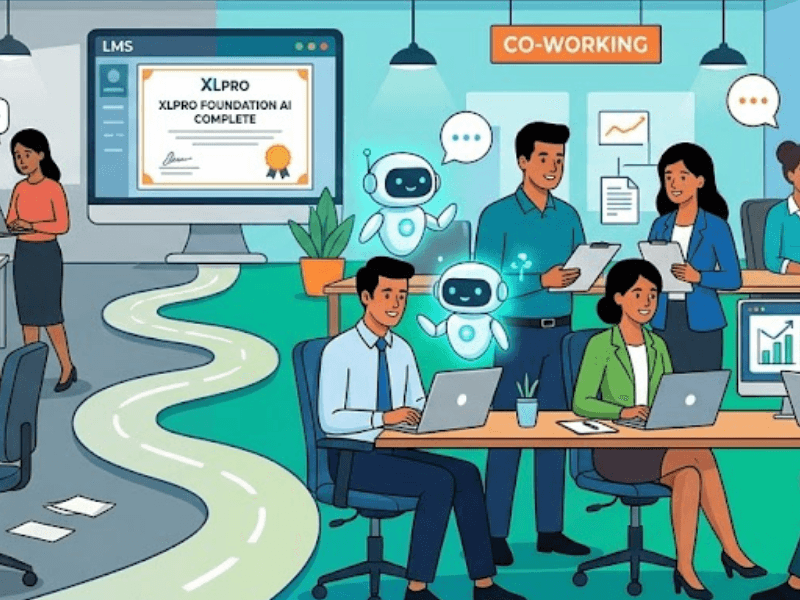
Looking for structured AI training for employees in India? XLPro’s Fundamentals of AI e-learning course gives every employee the same practical baseline on key topics like how to write effective prompts, evaluate AI outputs, and apply AI to their actual work. SCORM-ready, completable in 30 minutes, and deployable across your entire team in days.