AI conversations inside India’s Global Capability Centers-GCC ecosystem have changed noticeably in 2026.
Earlier, most discussions around AI were limited to technology teams, automation pilots, or innovation groups. Now the conversation has moved into everyday business operations. HR teams are using AI tools for drafting policies and communication. Finance teams have started using it for AI assisted reporting. Operations teams are testing workflow automation. Even managers who never actively followed technology trends are now trying to understand where AI fits into their teams.
The shift is happening faster than many companies expected.
India’s GCCs are also under pressure to move beyond traditional support functions. For years, GCCs were mainly seen as delivery centers focused on process execution and operational support. That image has changed significantly. Today many GCCs handle core business functions for global organizations including product engineering, enterprise analytics, cybersecurity, risk management, customer operations, and digital transformation programs and global organizations increasingly expect their GCCs to drive productivity and innovation at scale. AI naturally becomes part of that expectation.
This is especially visible in India where GCC expansion continues to accelerate across sectors like banking, financial services, healthcare, retail, manufacturing, and enterprise technology.
But there is one issue many organizations are running into. Global companies are investing heavily in AI capabilities across their India operations because this is where large talent pools already exist. But while the investments are growing quickly, workforce readiness is still uneven. Some employees are already using AI tools confidently in daily work. Others are still hesitant. Many are somewhere in the middle, experimenting with AI tools without clear guidance.
That gap matters more than companies initially assumed. That is where AI literacy in GCCs becomes important.
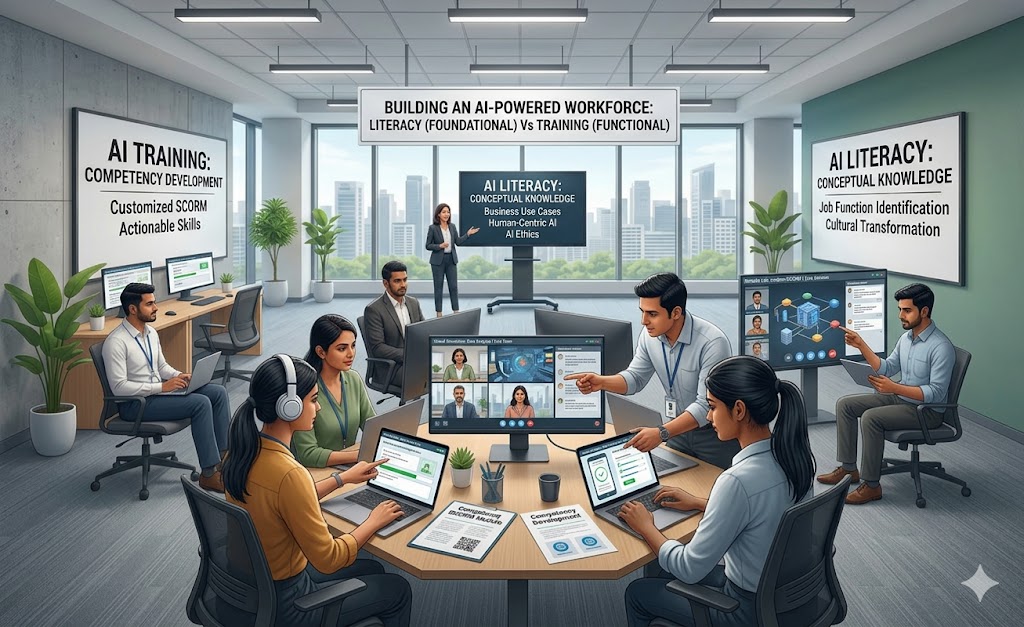
To understand the difference between AI literacy and AI training, read our blog here.
AI Literacy Is Not Just a Technology Skill
One of the biggest misunderstandings around AI training is that it only applies to technical teams. That may have been true a few years ago. It is not true anymore.
Today AI is influencing regular workplace activities across departments like:
- Writing emails
- Summarizing meetings
- Preparing reports
- Organizing information
- Researching data
- Creating presentations
- Drafting policies
- Automating repetitive tasks
Most employees are already interacting with AI in some form, even if indirectly through enterprise software but the real question is whether they know how to use it responsibly and effectively.
AI literacy in GCCs simply means employees understand:
- What AI tools can realistically do
- Where human judgment is still necessary
- How to ask better questions and prompts
- How to verify outputs
- What information should never be shared with AI tools
- Where AI can improve productivity without creating business risks
This is becoming basic workplace readiness. Not very different from how Excel, email, or internet research eventually became standard professional skills.
The Bigger Risk Is Unstructured AI Adoption
Right now, many companies are seeing employees learn AI randomly. Someone watches a few YouTube videos. Someone else experiments with prompts after seeing LinkedIn posts. A few teams start using AI heavily while others avoid it completely.
That creates inconsistency across the organization.
In some cases employees unknowingly paste confidential company information into public AI tools. In other cases teams become overdependent on AI-generated responses without properly checking accuracy. There are also employees who want to use AI but simply do not know where to start. This is why companies are beginning to realize that AI adoption cannot depend entirely employee driven self-learning.
Without structured AI training for employees, organizations end up with scattered usage instead of meaningful adoption.
GCCs Need Employees Who Can Work Alongside AI
One thing is becoming increasingly clear across GCC environments. Companies are not expecting every employee to become an AI engineer. But they do expect employees to become more aware about AI.
Managers want teams that can:
- Work faster without compromising quality
- Automate repetitive work sensibly
- Use AI tools responsibly
- Adapt quickly as enterprise AI systems evolve
The employees who understand how to work alongside AI tools will naturally become more valuable in most business functions. This applies across levels as well. Freshers entering GCCs are expected to be comfortable with AI-assisted work environments. Mid-level managers are expected to understand productivity implications. Senior leaders are expected to think about governance, efficiency, and workforce readiness.
Why Fundamentals of AI Training for Employees Matters in GCCs
Many organizations delay AI learning initiatives because they assume training needs to be highly technical or expensive. But most GCCs do not need advanced AI specialization for every employee. What they usually need first is foundational AI literacy. Employees need practical understanding before organizations move into deeper AI transformation programs.
The most effective AI learning modules are usually the ones that stay close to actual workplace usage:
- Practical examples
- Real business scenarios
- Responsible AI usage
- Prompt writing basics
- Productivity applications
- Simple explanations without technical overload
Employees generally learn faster when they can immediately connect training to daily work. For example if a finance professional sees how AI can simplify reporting work, adoption becomes easier. Similarly if HR teams understand how to use AI safely for communication drafts, confidence improves. Likewise if operations teams learn how AI can reduce repetitive tasks, resistance drops significantly.
The learning feels useful instead of theoretical.
How GCCs Can Start AI Literacy
As emphasized earlier, most organizations do not need to overcomplicate the starting point. What matters initially is building a common AI foundation across teams.
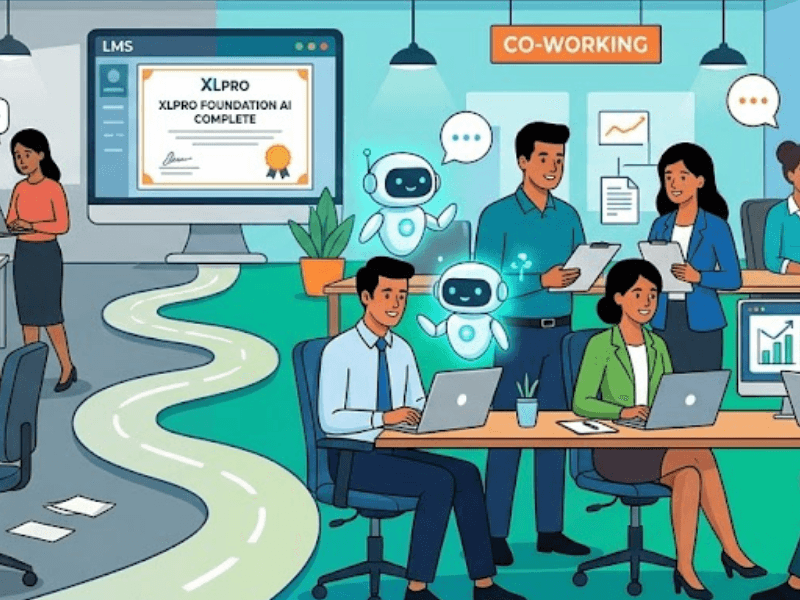
XLPro’s Fundamentals of AI e-learning course is designed around that exact need. Instead of approaching AI as a technical subject, the course focuses on how employees can actually use AI in workplace settings.
The course includes:
- Practical workplace scenarios
- Hands-on prompting basics
- Responsible AI usage
- Productivity-focused learning
- Simple business examples
- Easy-to-understand explanations
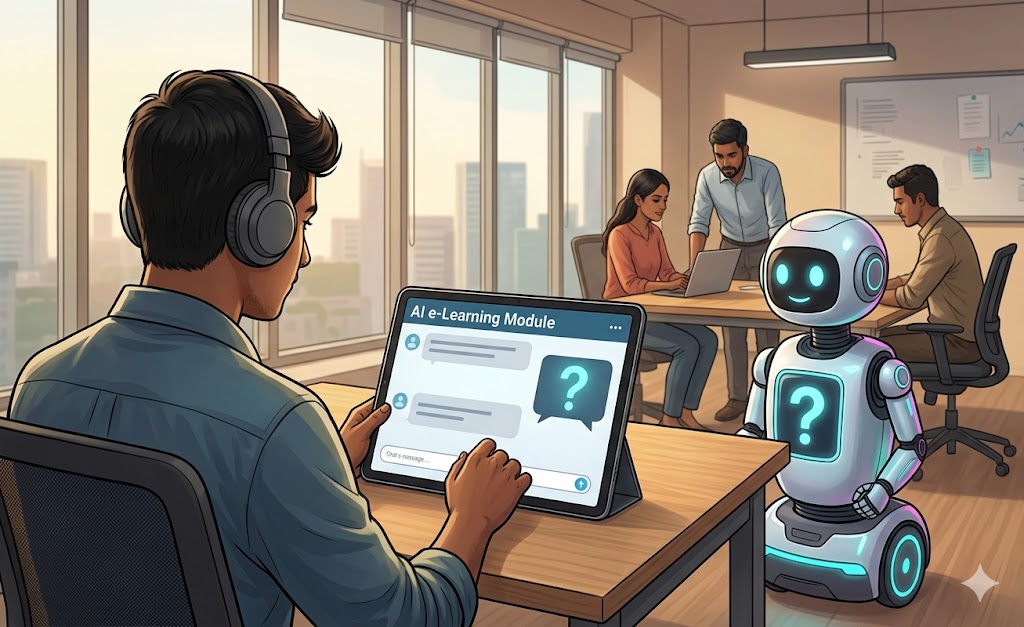
For GCCs, e-learning also makes rollout easier across large and distributed teams. GCCs can procure XLPro’s SCORM module on Fundamentals of AI for their LMS which, can then be used to train the entire workforce. Employees can learn at their own pace while organizations maintain consistency in training standards.
More importantly, foundational learning reduces hesitation. A lot of employees are curious about AI but are unsure how to begin. Structured learning gives them confidence without overwhelming them.
AI Literacy Will Soon Become a Basic Workplace Expectation
Many GCC leaders are now realizing that AI readiness is not only about technology infrastructure.
It is equally about workforce capability.
Companies can invest in AI platforms, enterprise copilots, and automation systems, but if employees are not comfortable using them properly, the business impact remains limited.
That is why AI literacy in GCCs is steadily moving from being a “good to have” skill to a core business skill.
Not because every employee needs deep technical expertise. But because modern workplaces are increasingly being built around AI-enabled workflows. And employees who understand how to work effectively in that environment will adapt much faster than those who do not.